QLLVM Introduction
QLLVM is a classical-quantum hybrid compilation framework built on LLVM, with excellent extensibility and seamless integration with classical high-performance computing ecosystems.
QLLVM supports multiple quantum programming languages and backends, including Qiskit, Cirq, QPanda, OpenQASM, etc. for programming languages, and OpenQASM 2.0, OriginIR, QCIS, etc. for backend instructions.
QLLVM supports unified compilation of quantum programs, CUDA programs, and classical C++ programs, providing an efficient, flexible, and industrial-grade compilation infrastructure for classical-quantum software development.
Overall Features
QLLVM compiles high-level quantum programs into target back-end executable code, with the following main features:
Multi-language front-end: Supports OpenQASM 2.0, Qiskit QuantumCircuit, QPanda, Cirq and other inputs
MLIR optimization: Single-qubit gate merging, cancellation, diagonal gate removal, gate synthesis and other optimization passes
QIR generation: Lowering MLIR dialects to QIR (quantum intermediate representation in LLVM IR form)
SABRE mapping: C++/Qiskit implementation of qubit layout and SWAP insertion
Multi-backend emission: Output OpenQASM, hardware-specific formats, etc.
Technical Route
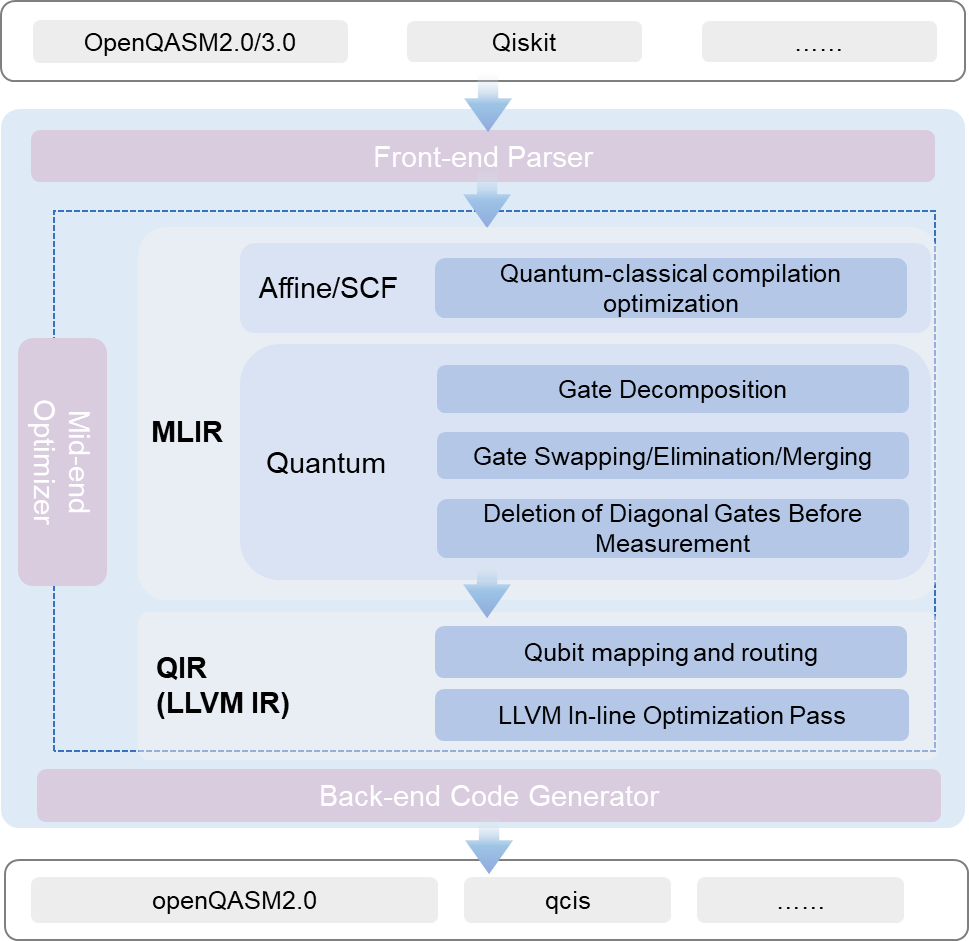
QLLVM Compilation Framework
Front-end: Responsible for language parsing and intermediate code generation, converting high-level languages to MLIR Quantum dialect
Middle-end: Perform quantum program optimization based on MLIR, and further lower MLIR to QIR (LLVM IR)
Back-end: Based on QIR and QIR runtime library, convert programs to code formats supported by target hardware
Leveraging the LLVM ecosystem, QLLVM can integrate with classical compilation passes, CUDA programming models, and HPC runtimes, enabling efficient compilation of classical-quantum hybrid tasks.
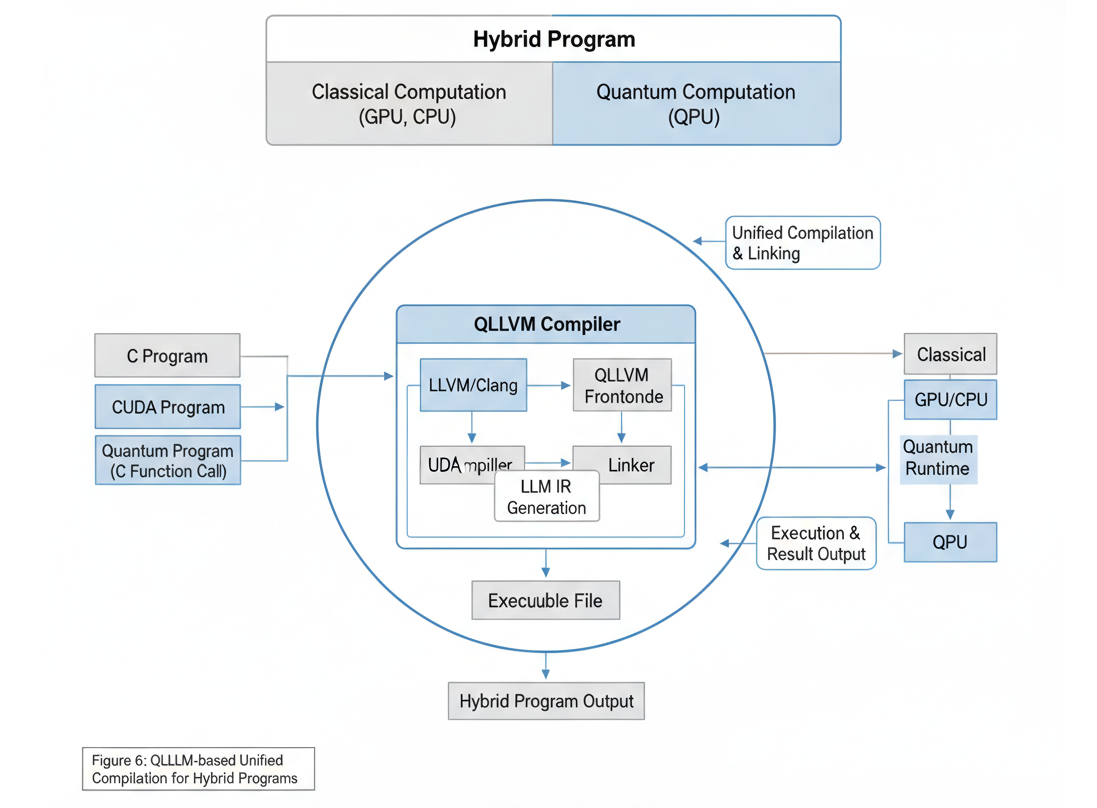
Classical-Quantum Hybrid Program Compilation Mechanism
Meanwhile, based on the LLVM compilation framework, the QLLVM compiler can work synergistically with various classical high-performance compilers, thus supporting the compilation of classical-quantum hybrid programs.
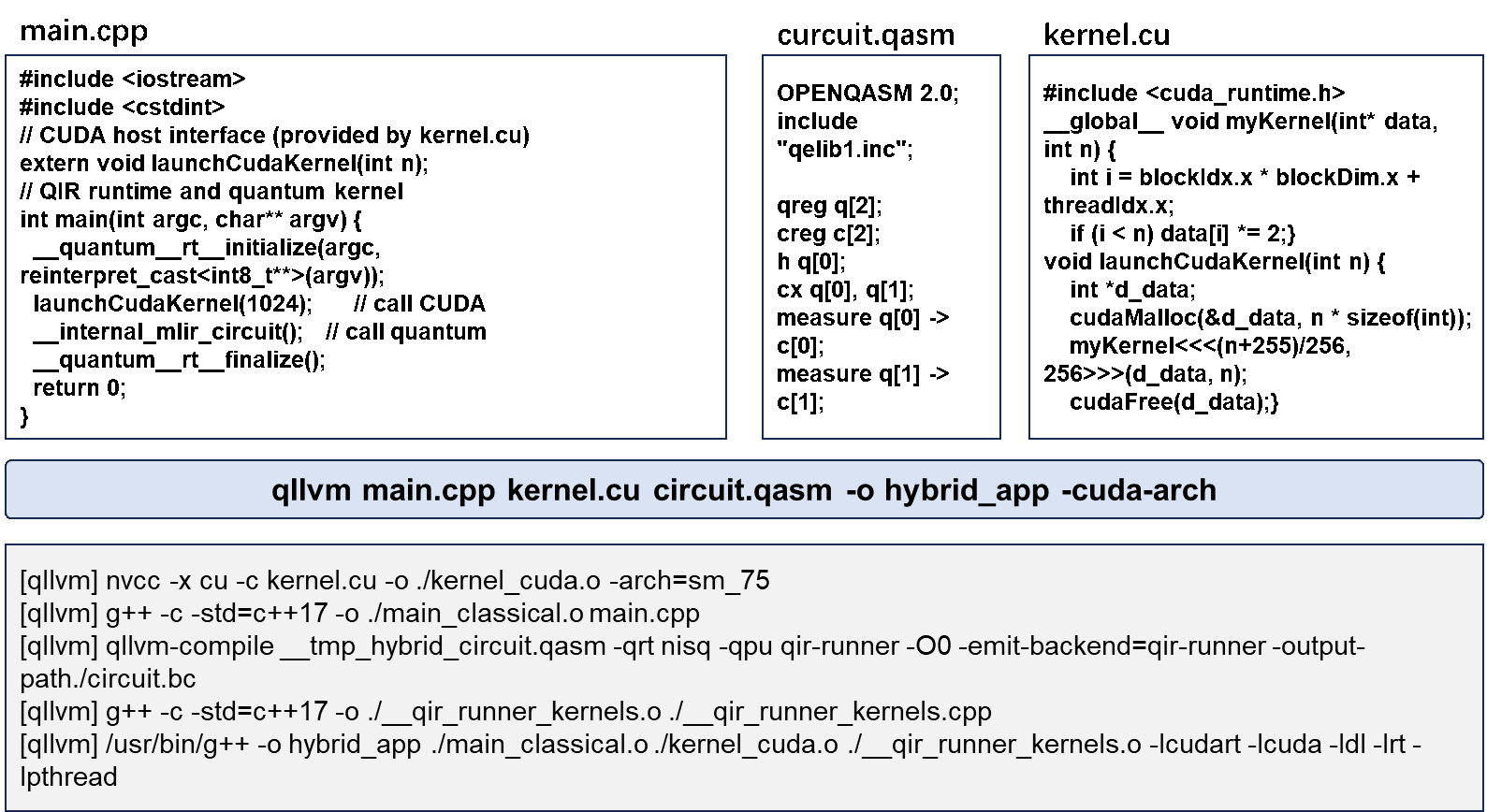
Hybrid Program Code Writing Example
Key Advantages
Industrial-grade IR infrastructure: Based on MLIR/LLVM, easy to extend new dialects and new passes
Multiple input forms: OpenQASM, Qiskit etc., adapting to different programming habits
Flexible optimization: -O0/-O1 levels, custom pass sequences, synthesis optimization
Physical constraint mapping: SABRE and other layout and SWAP strategies, adapting to real hardware topology
Project Structure Overview
Directory |
Description |
|---|---|
|
MLIR dialects, parsers, transforms, lowerings |
|
Quantum dialect definition |
|
OpenQASM3, Qiskit parsers |
|
Optimization passes (gate merging, cancellation, synthesis, etc.) |
|
|
|
LLVM IR passes (SABRE, etc.) |
|
QIR → backend code (e.g., QasmBackend) |
|
Driver script |
|
Tests and example QASM |
|
Installation guides, design documents |